
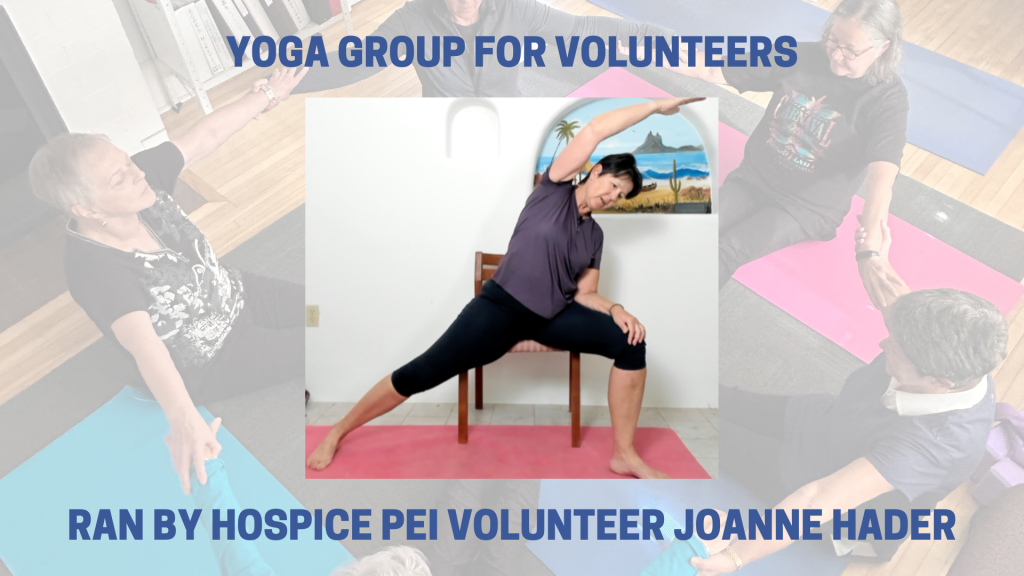
Full interview with Joanne Hader.
How did you first learn about Hospice PEI?
I was first exposed to end-of-life care when I did research on the use of hospital beds in the 1990s. One older gentleman in his 90s spent the last 350 days of his life in a huge hospital surrounded by bright lights and the repetitive sounds of machines monitoring and warnings beeping; all raising the anxiety of every patient and loved one close by. He spent his last year in this acute care facility, moving from department to department, getting test after test, treatment after treatment, visited by a constant stream of caring experts who did for him what they knew. He was from a small town, hours away. Even though he was surrounded by caring people, he was disconnected from community, family, and a long lifetime of memories. My heart ached when I realized he needed care very different from all our system had to offer. My mother died similarly under the bright lights of an operating room hallway with her husband and only one of her five children at her side.
Can you explain why you wanted to start the yoga group and what your goals for the group were?
I have been a Hospice volunteer since 2017 and practicing yoga for about 25 years. My practice has evolved and has supported me through most of the changes and challenges in my life. I attribute my mental and physical flexibility, my health and resilience, and my spiritual growth to living my yoga and to my continued ongoing study of yoga and Christian contemplative philosophy.
My goals in sharing yoga art at this stage in my life are fourfold: introducing people to deep relaxation and stress reduction through stillness; supporting people in a wellness-based movement practice; using the tools of yoga to nourish mind and body on and off the mat and most importantly, offering opportunities for connection—with the self, mind, and body, and with other people. One of the biggest challenges of our age is inclusion and connection and the looming elephant in every room is loneliness.
What was a favourite memory of the group?
We really laughed a lot. In one group a participant brought us jokes to share more than a few times, and another baked treats for us. We had tea. I loved to see their focus on following the movements and breath exercises. They asked a lot of great, and some tough, questions. We save the last 30 minutes of every session for connection. Their candor in sharing what were very personal observations and feelings was refreshing. I feel that meant that we had succeeded in creating a safe space together, another goal you see in a lot of yoga.
I made many new friends, and best of all participants seemed to appreciate the opportunity to connect with each other, and to be “in” a group. They shared contact information and I overheard that several planned to get together once the yoga sessions were done.
Why partner with Hospice PEI?
Because connection is so important I chose Hospice volunteers because of how isolating the work as a Hospice volunteer can be. My experience has been working alone, traveling to see clients alone, and few forums for sharing or debriefing on my experiences or concerns other than with the volunteer coordinators, who have a lot on their plates. Peers are huge in many organizations as support both formally and informally.
Any final thoughts?
Dharma in yoga and Eastern philosophies is about finding our calling. Many believe our life’s purpose is to find and do “what sets your hair on fire” and that oneness or connection is our natural state. Our dharma also changes. Today I am passionate about three things: getting people my age and older moving for their own health and well-being; connecting with others deeply and “soul to soul” and, when it is the right thing to do, simply being there for people, mostly in silence, so they experience oneness, that so important human connection until their very last breath.